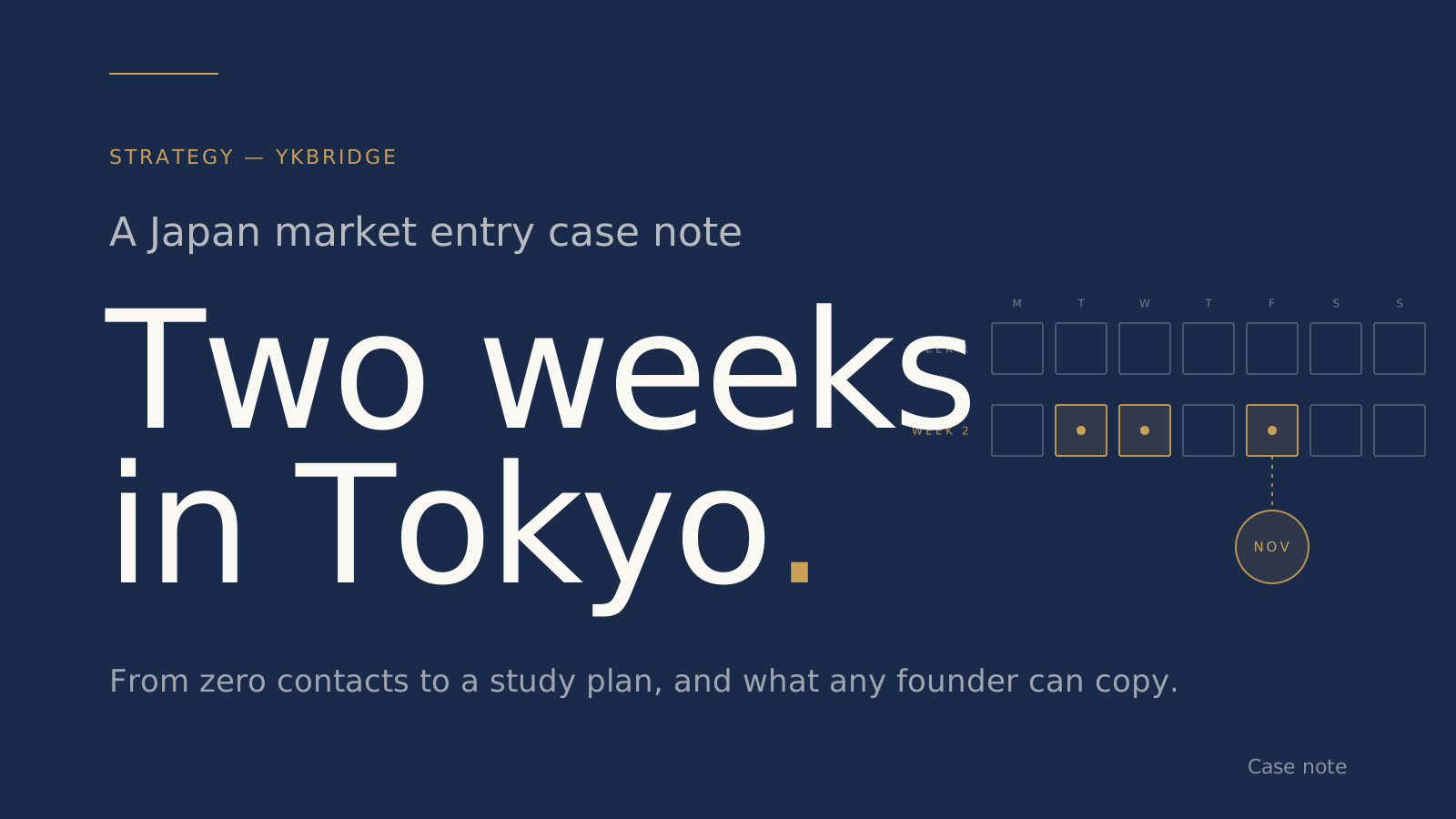
Short answer: two weeks in Japan is enough to find out whether the market wants your product, if the trip is built around three things: a local person in every meeting, the doors your own government can open, and the places where a product is tested rather than sold. Amical, a Québec startup whose AI companion lives inside a simple, screen-free phone for seniors with cognitive decline, arrived in Tokyo in October knowing almost no one there. It left with a study plan at a living lab inside a care home, an interview with the senior-care industry's trade weekly, a presentation to about forty people at one of the country's largest care operators and an invitation to come back in November. YKBridge supported the trip with Kenichi Oshima beside the team on the ground. This is what happened, why it worked, and what any founder planning a first trip to Japan can copy.
Who is Amical, and why Japan?
Amical was founded in Québec City in 2024 by Tony Aubé and François-Xavier Ratté. Its product is an AI companion for older people living with Alzheimer's and other cognitive disorders, delivered through the most familiar device imaginable: a telephone. There is no screen, no app and nothing to learn. The person picks up the handset and talks. The companion holds a natural conversation, can be personalised to each person, and can place scheduled calls for check-ins and reminders. It is also a real phone. Amical is already in use in memory-care homes in Québec.
Japan is an obvious place for a product like that, and a hard one to enter. It has one of the oldest populations in the world, a large and growing number of older people living alone, and a care sector that is short of staff and under constant cost pressure. It also has a long habit of testing care technology on the floor, with residents and staff, before anyone signs a purchase order. For a company of Amical's size, that habit is the opportunity: Japanese care operators and researchers will look seriously at an unproven foreign product if someone they trust brings it to them and the product can be tried.
What happened in two weeks?
Tony Aubé and the Amical team spent two weeks in Tokyo in October. Kenichi Oshima, whom YKBridge brought in to support Amical locally, was at every meeting. By the second week, the calendar looked like this.
At the Care Tech ZENKOUKAI Lab, a living lab run inside a Tokyo care home where new technologies are tested with real residents and staff, the team toured the facility, left a phone behind and started writing a study plan with the lab.
The same day, Amical gave an interview to 週刊高齢者住宅新聞, the weekly trade paper of Japan's senior-housing and care industry, which says it is read by 70 of the country's 100 largest care operators. Trade coverage within two weeks of arriving is rare for a foreign startup.
At TMIG, the Tokyo Metropolitan Institute for Geriatrics and Gerontology, a research team working on seniors who live alone with cognitive decline was particularly interested in Amical's automated calls. They invited the team back in November.
The week closed with a meeting at DIC Corporation and a presentation to about forty people at the GENBA SMILE Lab of NICHII GAKKAN, one of Japan's largest care operators.
Behind the calendar stood the Embassy of Canada to Japan, the Canadian Government Trade Office in Osaka and the Délégation générale du Québec à Tokyo, which helped Amical reach researchers. Two weeks earlier, in Amical's own words, the team barely knew anyone in Japan.
What made it work?
Five things, none of them expensive.
A local person in every meeting. Not an interpreter booked by the hour, and not a consultant who sets up the meetings and goes home. Kenichi sat in each conversation, read the room, handled the follow-up in Japanese and kept the next step moving after the team flew home. In Japan, the meeting is the easy part. What happens in the ten days after it decides whether there is a second one.
The doors your own government can open. Embassies, trade offices and provincial delegations exist to make introductions for companies from home, they do it for free, and most founders never ask. Amical asked. The Canadian and Québec offices in Japan connected the team to researchers and institutions that a cold email would not have reached. Whatever your home country, this is the first call to make, months before the flight.
Go where the product is tested, not where it is sold. Amical did not spend two weeks pitching procurement departments. It went to a living lab inside a care home, a geriatrics research institute and an operator's own innovation lab, the three places in Japanese care where a new product gets tried with real users. Japanese buyers want evidence from Japan before they buy. The fastest way to get it is to put the product in the hands of the people who generate that evidence.
Talk to the trade press early. Every Japanese industry has a trade paper that its decision makers actually read, and in a concentrated industry like care one weekly can reach most of them. An interview in week two gave Amical something a sales deck cannot: a Japanese third party describing the product in Japanese, which every later conversation can start from.
Leave something behind, and set the next date before you leave. Amical left a phone at the living lab. It left Tokyo with the November visit already in the calendar. A device on a desk and a date in a diary are what keep a foreign company present after it has gone home, and they are the difference between a trip that produces business cards and a trip that produces a programme.
What has not happened yet?
A study plan is not a purchase order, and nobody should read it as one. In Japanese care, as in most Japanese B2B markets, the usual order is evidence first, then a reference site, then procurement, and the sequence tends to run across the April budget year rather than inside one. We have written before about why the first 90 days in Japan are not about sales and about why autumn is Japan's real budget season. Both apply here.
So the next ninety days for Amical look less exciting than the first two weeks and matter more: turning the study plan into a protocol with dates and names, staying in monthly contact with everyone met in October, preparing Japanese-language materials for the operators who asked for them, and arriving in November with something new to show rather than a repeat of the first visit.
What does this mean if you are planning your first trip?
Three things.
First, two weeks is enough if the calendar is built before you board, not after you land. Six to eight weeks of outreach beforehand, through your embassy, your trade office and a local lead, is what fills it.
Second, decide which kind of meeting you want. A first trip aimed at pilots, studies and reference sites will end with a next date. A first trip aimed at closing sales will end with polite interest and a long silence, because the people you met cannot buy without evidence you do not yet have.
Third, none of this requires a Japanese company. Amical ran the trip from Québec with a local lead on the ground. Whether you need a Japanese entity is a question for after the market has answered, not before.
How YKBridge supported Amical
YKBridge placed Kenichi Oshima with the Amical team as its local lead for Japan: attending every meeting, handling follow-up in Japanese and carrying the relationships between visits. It is the same hands-on model we use for the companies we support as fractional Country Manager, scaled to what a first trip actually needs.
If you are planning a first trip to Japan and want it to end with a study plan rather than a stack of business cards, book a 30-minute fit call. And if you run a care facility in Japan and would like to see Amical's phone, contact us and we will arrange an introduction to the Amical team.
Frequently asked questions
How long should a first business trip to Japan be? Two weeks is a practical minimum if the calendar is built in advance. Shorter trips tend to be filled with introductions that need a second meeting to go anywhere.
Can a foreign startup get Japanese trade press coverage? Yes, and earlier than most expect, if a trusted introducer makes the approach and a Japanese-speaking person handles the interview and the follow-up. Trade papers in Japan cover new entrants when the story is relevant to their readers.
Do you need a Japanese entity to run a study or pilot in Japan? Usually not. Studies, pilots and reference installations can be run from abroad with a local lead and, where needed, a Japanese partner handling local logistics. The entity question comes later.
Details of Amical's October meetings are drawn from Amical's own public account of the trip and appear here with Amical's agreement; product information is from Amical. This article describes one engagement and general market-entry practice in Japan as of November 2026 and is not legal or regulatory advice.