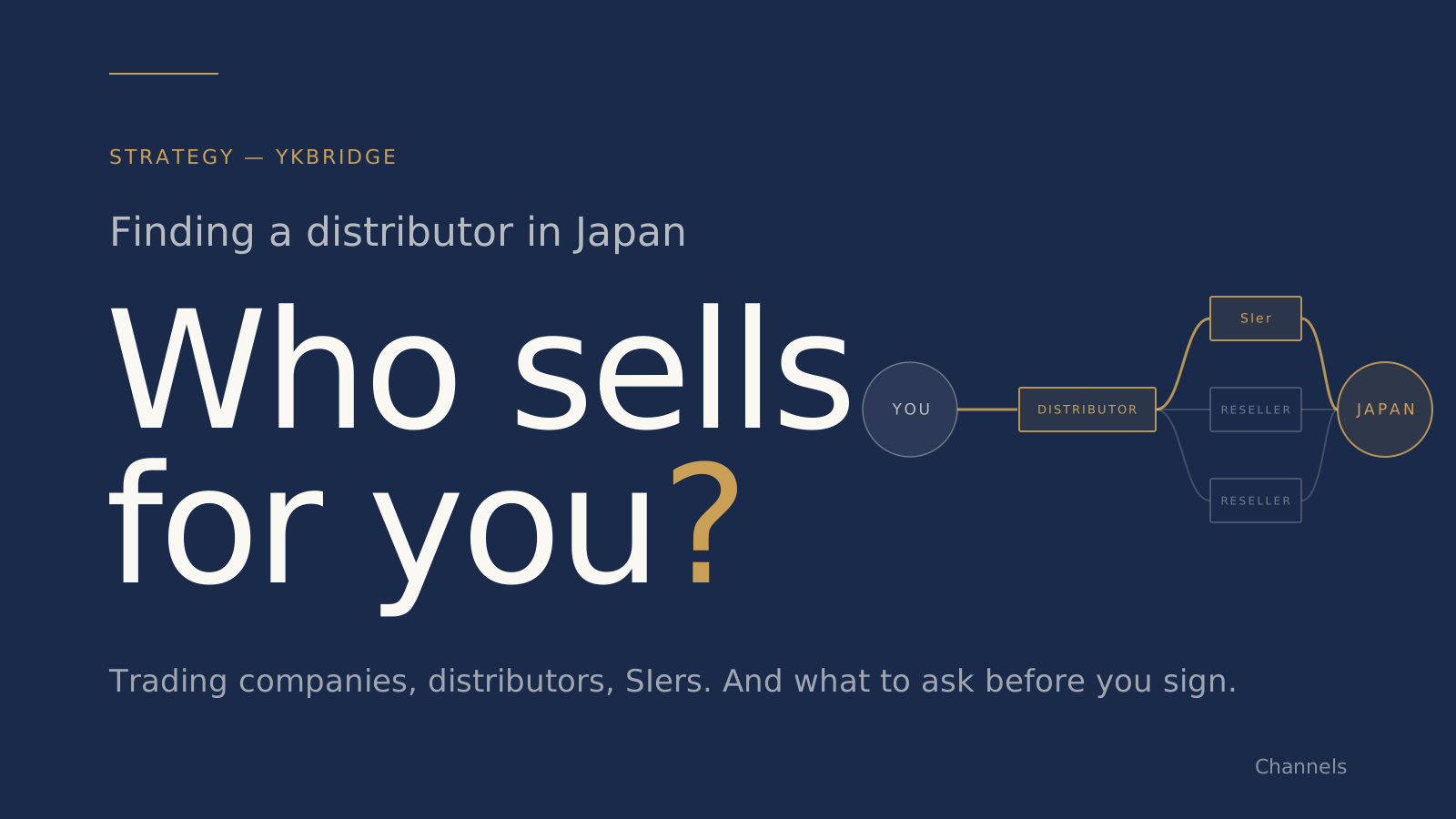
Short answer: you do not find a distributor in Japan by searching for one. You find the companies that already sell to your buyers, work out which of them has a gap your product fills, and get introduced. The channel has four distinct kinds of partner (general trading companies, specialist trading companies and distributors, system integrators, and resellers), and they want different things from you. Before you sign anything, ask three questions: which named accounts will buy in the first twelve months, what share of the partner's revenue you will be, and how the relationship ends. Then sign for one year, non-exclusive, with your trademark already registered in Japan, and plan to do the first ten deals together. A Japanese distributor sells what already sells. Your job in year one is to make your product one of those things.
"Can you introduce us to a distributor?" is the second most common request we get after "do we need a Japanese entity?" It is a reasonable request, and the answer is usually yes. But it comes with a misunderstanding attached: that a distributor is a sales force you rent, and that once the contract is signed, Japan is handled. In practice, a Japanese channel partner is closer to a retailer with a trusted shelf. The shelf is valuable because the customers trust it. What goes on the shelf, and whether anyone points customers to it, is still your problem.
This article is about the part between "we should use a distributor" and the first order: what the Japanese channel looks like, where partners are found, how to evaluate them, and what the contract should say.
What does the channel in Japan actually look like?
Foreign companies tend to use "distributor" for everything. In Japan the word covers at least four different animals, and sending the same pitch to all four wastes months.
| Partner type | Who they are | What they bring | What they want from you | Typical economics |
|---|---|---|---|---|
| General trading company (sogo shosha) | Mitsubishi, Mitsui, Itochu, Sumitomo, Marubeni, Toyota Tsusho, Sojitz and their hundreds of subsidiaries | Access to very large accounts, project finance, joint ventures, a brand that opens any door | Scale, a strategic story, often equity or an exclusive arrangement; a slow internal process to get there | Commission or JV economics; rarely a simple margin |
| Specialist trading company or distributor (senmon shosha) | Industry-specific importers and wholesalers: machine tools, chemicals, electronic components, medical devices, food ingredients | Stock, import handling, Japanese-language technical support, accounts that have bought from them for decades | A product that fits their existing catalogue and customers, Japanese documentation, stable yen pricing, a commitment to stay | 15–35% for the importer or master distributor, depending on what it takes on; 5–15% for each further wholesale tier |
| IT distributor (two-tier) | The national distributors who sit between software and hardware vendors and thousands of resellers and system integrators | A route to resellers you could never reach one by one; credit, logistics, licensing administration | Products resellers already ask for, a partner programme, a Japanese support desk behind them | Roughly 5–15% at the distributor (it buys at 60–70% of list), 20–30% at the reseller (which buys at 70–80%) |
| System integrator (SIer) | NTT Data, Fujitsu, Hitachi, NEC, NRI and hundreds of mid-sized integrators | The implementation relationship with large enterprises; for anything touching core systems, they are the route, not an alternative | Vendor status: certified engineers, Japanese documentation, a support escalation path, deal registration | Resale margin plus the services revenue around your product, which is what they actually care about |
| Reseller or VAR | Regional and vertical resellers, often buying through an IT distributor | Mid-market and regional accounts, local presence outside Tokyo | Leads, simple pricing, something that sells without much explanation | 20–30%, buying at 70–80% of list; little demand creation |
Two things in this table surprise people.
The first is two-tier distribution. In Japanese IT, most resellers and integrators do not buy from vendors; they buy from a handful of national distributors. If you want five hundred resellers to be able to quote your product, you sign one distributor, not five hundred resellers. That distributor will not create demand for you. It will make your product orderable, and it will tell you honestly whether resellers are asking for it.
The second is the general trading company. Founders arrive with "we are talking to Mitsubishi" as if it were a channel. It can be, for industrial projects, infrastructure and anything that benefits from a sogo shosha's balance sheet. For a B2B software or component business looking for its first ten customers, it is usually the slowest possible route: the trading houses look for volume and brands, and their internal approval to carry a new foreign product is itself a sales cycle that runs a year or more. The EU-Japan Centre's guide for European exporters says plainly that they are not the partner for small-volume business. Our B2B sales guide covers how those cycles run.
Where are the good partners found?
Not on a list. The partners worth having are busy, do not advertise for principals, and are approached by foreign vendors every week. They say yes to introductions, not to cold email. Here is where the introductions come from, roughly in order of how well they work.
Your competitors' websites. Every established foreign vendor in Japan lists its Japanese partners, usually on a page called 取扱企業, パートナー or 販売代理店. Those companies already sell to your buyers and already know how to carry a foreign product. The ones carrying a competitor are not off-limits: a distributor that is losing share with one vendor is often the most motivated to add a second.
The buyers themselves. When a prospective customer likes your product but cannot buy direct, ask who they buy similar things from. A distributor introduced by its own customer takes the meeting, and arrives knowing there is a deal attached.
Trade shows, as a visitor. Japan's industry shows are where the channel is physically assembled. The machine-tool show, the medical-device shows, the manufacturing and IT weeks: distributors exhibit alongside the vendors they carry, and their staff will tell you in ten minutes what they are looking for. Walk the show with a list of twenty booths and leave with five real conversations. It costs a flight and a badge.
Industry associations. Japanese industry bodies keep member directories and, more usefully, secretariats who know which members are actively looking for new lines. A polite, specific request through the right association produces introductions that no amount of outreach will.
JETRO, the chambers and your own government. JETRO's J-Bridge platform (over 1,380 companies registered) is built for open innovation between foreign technology companies and Japanese corporates in digital and green fields rather than for appointing resellers, but its corporate members and its partner-finder database are a legitimate way into companies that also run channels, and JETRO's investment support centres will point you to the right trade bodies. The bilateral chambers (the American, British, European, German and Dutch chambers in Tokyo among them) have members who are precisely the people you want to meet. Export agencies run paid searches too: the US Commercial Service's International Partner Search, for example, delivers a list of up to five Japanese partners who have expressed interest in your product for $2,500. The lists are a starting point, not a shortcut; the introduction still has to be made in person.
Someone who already has the relationships. This is the honest answer for most companies. A person in Japan who has worked the channel in your industry can usually name the five right candidates in an afternoon, and get three of them to a meeting within a month. Whether that person is a hire, an agency or a fractional Country Manager, the introduction is what you are paying for.
What does not work: posting "distributor wanted" anywhere, buying lists, and LinkedIn outreach. Japanese channel managers are rarely active on LinkedIn, and an unsolicited approach from a foreign vendor with no Japanese presence reads as risk, not opportunity.
How do you tell a partner from a catalogue listing?
Most distributor relationships fail quietly. The contract is signed, the product goes into the catalogue, and nothing happens, because the partner's salespeople keep selling what they already know. The evaluation stage is where you prevent that, and three questions do most of the work.
1. "Which three of your existing accounts will buy this in the first twelve months, and who in your company will own those conversations?" A real partner names accounts and a person. A catalogue partner talks about market potential. If no one can name three customers, the partner does not yet believe in the product, and no contract will change that.
2. "What share of your revenue will we be next year, and what would make this worth your sales team's time?" The answer tells you where you will sit in their priorities. A ¥10 million line inside a ¥5 billion distributor is 0.2% of their business and will get 0.2% of their attention. The same ¥10 million inside a ¥300 million specialist is a reason for the president to come to meetings. Bigger is not better. Relevant is better.
3. "If this does not work, how do we end it?" Notice period, remaining stock, who keeps the customer records, who supports the customers already signed. A partner who has thought about this is a partner who has done it before. One who finds the question rude is telling you something about how the ending will go.
Beyond the three questions, check four things. Whether they carry a direct competitor (if so, you are a negotiating chip, not a product). Whether anyone technical in their company can explain your product without you in the room. What their other foreign principals say about them, which they will tell you readily if asked in person. And whether they have ever dropped a foreign vendor, and why.
What will they ask you?
The evaluation runs both ways, and Japanese distributors have been burned. Many have carried a foreign product, built a customer base, and watched the vendor pull out of Japan two years later, leaving the distributor holding the support obligations. Expect to be asked, directly or indirectly:
Who is in Japan? A name, a phone number that answers in Japanese business hours, and a person who will come to customer meetings. Not a regional manager in Singapore.
Is the documentation in Japanese? Not just the brochure. The manual, the spec sheet, the price list, the support process, the security questionnaire answers.
What happens to pricing when the yen moves? Distributors buy in your currency and sell in yen. With the yen where it has been, a vendor who re-prices every quarter is a vendor whose product cannot be quoted. Annual yen price lists, with a documented review mechanism, are the norm.
Are you here in three years? This is the real question under all the others. A three-year plan, a reference customer, and a person on the ground answer it. An entity does not.
Who else are you talking to? Channel conflict is a serious concern. If you intend to sell direct to large accounts and through the partner to everyone else, say so, and put it in writing.
What should the contract say?
Use your own template, in English with a Japanese translation, and expect the Japanese version to prevail with Japanese partners. The terms that matter most:
Term and exclusivity. One year initial, non-exclusive, renewable, is the best opening position. Expect the request for exclusivity anyway: in Japan it is the norm, not a power play, and the request for a 総代理店 (sole agency for all of Japan) will come early. If you grant it, grant it for a defined segment or region, for twelve to twenty-four months, against a minimum purchase commitment, with renewal conditional on the benchmarks and exclusivity falling away automatically if they are missed. Exclusivity without a minimum is a lock on your product with no key.
Trademark. Register your mark at the Japan Patent Office before you sign. Japan is strictly first-to-file, the official fees are modest (about ¥12,000 per class to file and ¥32,900 per class to register for ten years), and the process takes roughly eight to twelve months, so start early. We have seen distributors register a foreign principal's mark in their own name, in good faith as often as bad, and the principal discover it only when the relationship ends. Registered trademark in your name, licensed to the partner for the term of the agreement, is the only arrangement that protects you.
Pricing. You may publish a recommended retail price. You may not control the partner's resale price; resale price maintenance is illegal in principle under Japan's Antimonopoly Act and the JFTC's distribution guidelines (revised again in July 2026), and a contractual "fixed price" clause is both unenforceable and a liability. Agree your transfer price, the currency, the review timing, and who carries exchange risk.
Territory, channels and reporting. Which customers, which channels, and what the partner reports to you: a quarterly pipeline, the names of customers signed, and a forecast. Without the names, you will one day be negotiating with a partner who knows your customers and you do not.
Support and training. Who provides first-line support, in what language, within what hours; what training you deliver and how many of their staff you certify; what marketing funds exist and who approves spending.
Termination and what happens after. Notice period (three to six months is common in contracts; thirty days appears in some Japanese templates and is too short for a relationship you want to end cleanly), stock buy-back at the transfer price, transfer of customer records, and a handover of support. Japanese courts treat long-standing distribution relationships as "continuous contracts" and limit the freedom to end them. The Supreme Court's 1998 Shiseido and Kao decisions accepted termination where the distributor had breached, but lower courts have required a justifiable reason or substantial notice where there was none, and the Tokyo District Court in 2010 held that a wine importer cut off without adequate notice was owed compensation equivalent to a year's notice. The clearer the contract is about how the relationship ends, the less room there is for that argument.
Governing law and disputes. Japanese law is not a disaster for a foreign principal, and partners often insist on it. If you want neutral ground, arbitration in Tokyo (JCAA) or Singapore (SIAC) in English is a reasonable compromise that Japanese counterparties generally accept.
Payment. Bank transfer on the Japanese close-and-pay cycle is the norm: 月末締め翌月末払い, close at month-end and pay at the end of the following month, which works out at 30 to 60 days. Japan's traditional promissory notes (tegata), with their 90- and 120-day maturities, are on their way out: the big banks have stopped issuing them, the amended subcontracting law prohibits them for covered transactions from January 2026, and the paper clearing system is scheduled to close at the end of March 2027. A partner proposing tegata is proposing a payment term from a previous era.
What do the first twelve months look like?
Signing is the beginning. The pattern that produces a working channel looks like this.
In the first quarter, you build what the partner's salespeople will actually use: a one-page Japanese product sheet, a yen price list, a set of answers to the ten objections, a demo that runs in Japanese, and two or three certified engineers on their side. You agree a target list of twenty accounts drawn from their existing customers.
In the second and third quarters, you go on the calls. Joint visits (同行, doko) are the norm in Japan, and they are where the partner's salesperson learns how the product is sold, by watching you sell it. Expect to be in Japan, or to have your person in Japan, in the room for the first ten opportunities. A partner left to sell alone sells what they already know.
By the fourth quarter, you want one lighthouse customer the partner can point to, a pipeline review that happens every quarter whether or not there is news, and a renewal conversation that is about expanding the target list, not about whether the relationship continues.
Through all of it, protect the partner. Register their deals, do not quietly sell around them, and do not let your headquarters sign a direct contract with a customer the partner brought in because the numbers were nicer. In a market this small and this well connected, the second distributor you approach will already know what you did to the first.
When should you not use a distributor at all?
Three situations, which between them cover a surprising share of foreign B2B companies.
When you are selling software or services to a handful of enterprise accounts, and the sale is consultative. A distributor adds margin and a layer between you and the customer, and does not add the thing you need, which is someone senior in the room. Sell direct, with a person in Japan, and bring in an SIer only when the implementation requires one.
When your buyer needs to see you. Regulated buyers, large enterprises and anyone making a multi-year commitment want to evaluate the vendor, not the reseller. The channel can transact the deal; it cannot stand in for your presence.
When you have not yet proven the product sells in Japan. Partners sell what sells. Asking one to create the market for an unknown foreign product is asking them to do your job at their expense, and the good ones decline. Close your first two or three customers yourself (most companies can, without an entity), and approach the channel with references in hand. The conversation is entirely different.
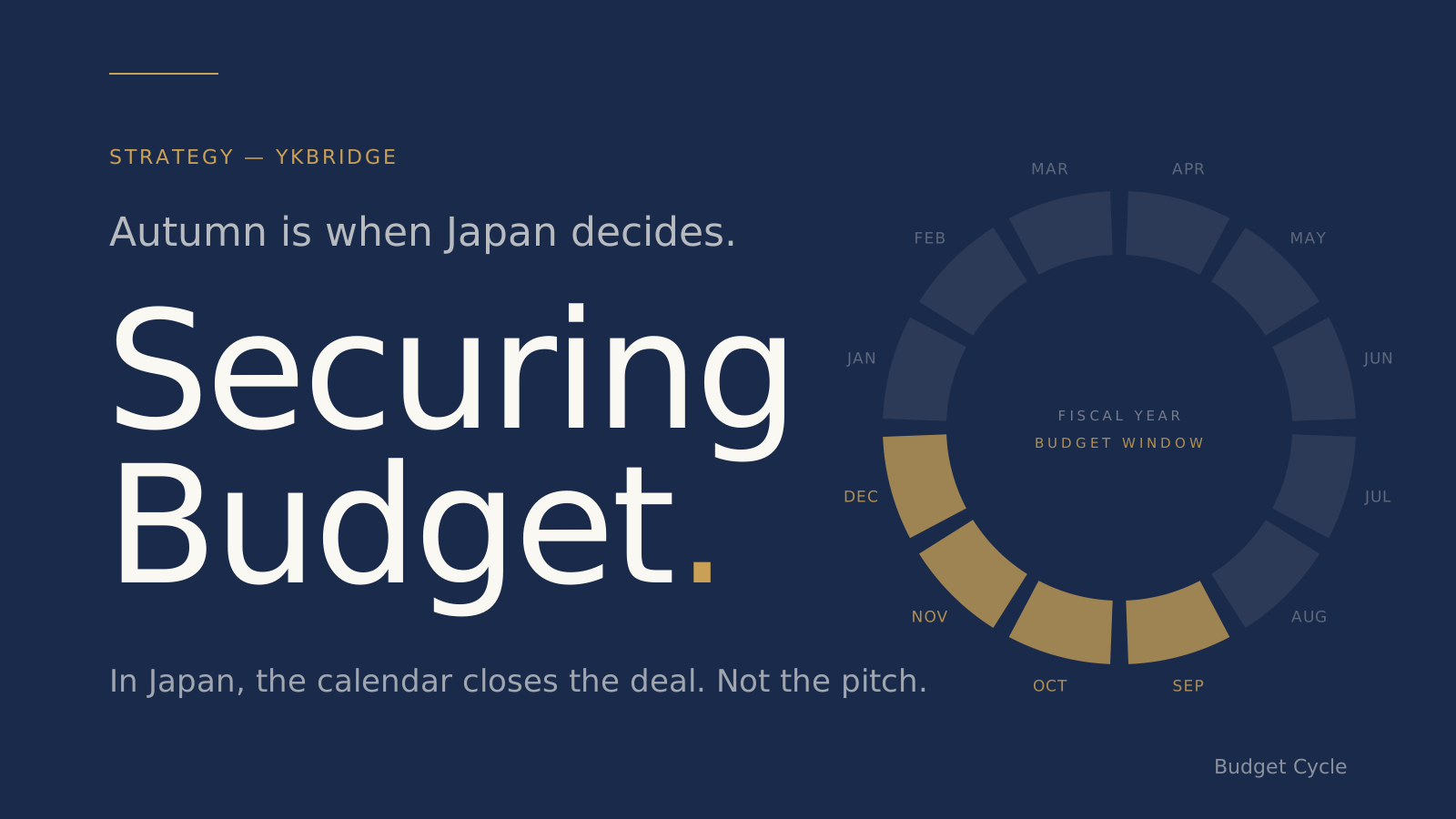
If you are reading this in the autumn, note that the partner's budget year, like your customers', most likely starts in April, and the planning for it is happening now. A distributor signed in January can be in the April plan. One signed in May waits a year.
Frequently asked questions
Do we need an exclusive distributor in Japan? No, and in year one you should avoid it. Grant exclusivity, if at all, for a defined segment and period, against a minimum commitment that ends the exclusivity if missed.
Is a distributor the same as a sales agent? No. A distributor buys your product and resells it in its own name, with stock and a margin. An agent introduces customers who contract with you, and earns a commission. Japan does not have the statutory agent-compensation regime that the EU has, but long-term relationships of either kind attract protection from the courts when they are ended abruptly.
What margin do Japanese distributors expect? For an importer or master distributor carrying stock and providing support, 15–35% of the wholesale price depending on what it takes on, with 5–15% for each further wholesale tier and 25–45% at retail for consumer goods. In two-tier IT distribution, the vendor typically supplies the distributor at 60–70% of list and resellers buy at 70–80%, so the distributor keeps roughly 5–15% and the reseller 20–30%. System integrators care less about margin on your product than about the services revenue around it.
How long does it take to sign a distributor in Japan? Six to twelve months from the start of a search to a signed agreement is the common estimate: one to three months to identify candidates, two to four for meetings and due diligence, two to four to negotiate. A warm introduction and ready Japanese materials are what shorten it. The EU-Japan Centre's experience with genuinely new products runs to two years or more, and the internal approval process at a large trading company can take longer than a year on its own.
Can we sell through a general trading company? Yes, for the right kind of business: industrial projects, infrastructure, anything needing finance or a joint venture. For a first ten customers in software or components, a specialist distributor or an SIer is faster.
Can we terminate a distributor agreement in Japan? Yes, in accordance with the contract, but build the ending into the agreement: a clear term, a notice period, stock buy-back and customer handover. Japanese courts treat long-standing distribution relationships as continuous contracts and have required a justifiable reason or adequate notice to end them; in one Tokyo District Court case the measure of damages was a year's notice.
Should we register our trademark before appointing a distributor? Yes. Japan is first-to-file. File at the Japan Patent Office before you sign (about ¥45,000 per class in official fees, eight to twelve months), and license the mark to the partner for the term of the agreement. Recovering a mark registered by a former partner is slow, uncertain and expensive.
Sources for the figures above: the EU-Japan Centre for Industrial Cooperation's guide to importers and distributors in Japan; the Japan Patent Office schedule of fees; the JFTC's distribution guidelines; JETRO's J-Bridge and the US Commercial Service's International Partner Search; Japanese practitioner commentary on the termination of continuous contracts and on reseller and distributor pricing; and reporting on the phase-out of paper promissory notes.
This article describes the general shape of the Japanese channel and its contract practice as of October 2026 and is not legal advice. Competition law, trademark procedure and the treatment of long-term contracts have specifics that depend on your situation; confirm them with a qualified adviser in Japan before you sign.