Short answer: no, not to start. A foreign company can contract with, invoice and support Japanese enterprise customers directly from abroad, and most of the companies we work with close their first Japanese deals exactly that way. A Japanese entity becomes necessary in four situations: the activity itself is regulated in Japan, you want employees in Japan on your own payroll, a specific buyer's procurement rules require a domestic vendor, or you are importing and holding goods. Until one of those applies, the entity is a cost and a distraction. What you need in year one is a person in Japan, a Japanese-language proposal your champion can forward, and a plan for four practical frictions: consumption tax, withholding tax, vendor registration and the contract itself.
The question comes up in almost every first call. "Do we need a KK before we start selling?" It usually comes from a reasonable place. Someone has read that Japanese companies prefer to buy from Japanese companies, or an adviser has quoted an incorporation package, or a competitor has a Tokyo address on its website. The honest answer is that the entity rarely decides whether you win the deal. The person in front of the customer does, and the paperwork behind the first invoice does. This article is about the second part, because it is the part nobody explains until it has already cost you a quarter.
What are the three ways to sell in Japan?
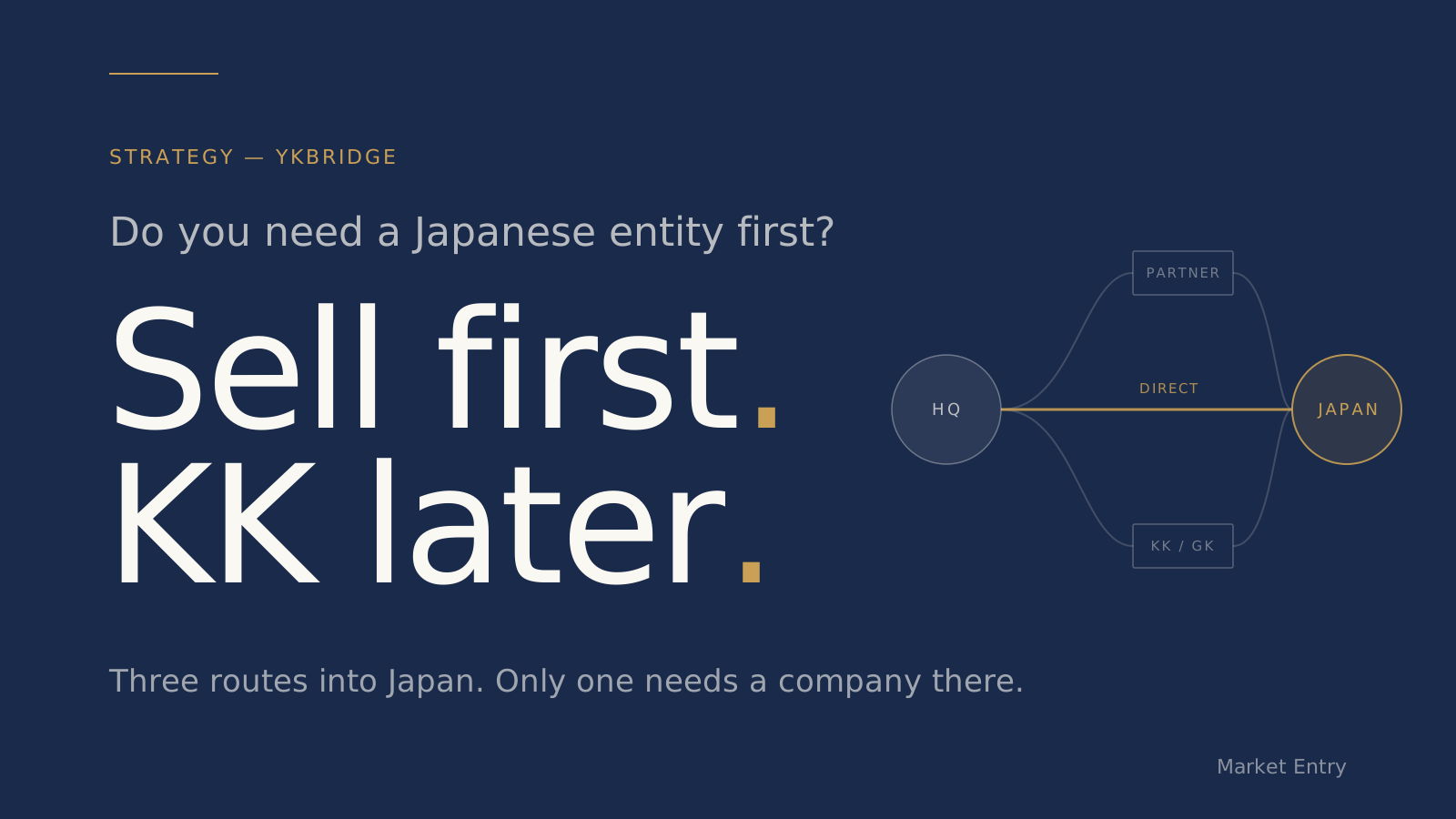
There are only three structures, and most companies end up using two of them at different stages.
Route 1: sell directly from your home entity. The Japanese customer contracts with your US, UK, Singapore or Dutch company. You deliver from abroad, with a representative in Japan running the meetings. The customer pays your foreign bank account, in yen or in your currency.
Route 2: sell through a Japanese partner. A system integrator, trading company, distributor or reseller contracts with the end customer, invoices in yen, provides first-line support, and buys from you. How those channels work is covered in our B2B sales guide; the short version is that the partner owns the relationship and takes a margin for it.
Route 3: set up your own Japanese company. A kabushiki kaisha (KK), a godo kaisha (GK) or a branch office. You hire locally, invoice locally and carry the compliance.
| Route | What the customer signs | Time until you can invoice | Year-one cost, before people | Best for | Watch out for |
|---|---|---|---|---|---|
| Direct from abroad | A contract with your home entity, usually bilingual with Japanese prevailing | Immediately | Treaty paperwork, a Japanese-law review of your contract, bank and FX fees: typically under $10k | SaaS, data, software and services sold to enterprises; your first one to three customers | Vendor registration, withholding tax on anything the buyer calls a royalty, procurement rules that require a domestic entity |
| Through a Japanese partner | A contract with the partner; you contract with the partner separately | One to four months to sign the partner | A margin of roughly 20–40% of each deal, plus the time to train the partner's sales team | Hardware, anything needing on-site support, accounts led by a system integrator, regulated buyers | You are one line in their catalogue; exclusivity requests; slow when you are not their priority |
| Your own entity | A contract with your KK or GK | Four to eight weeks to incorporate, then one to three months for a bank account | ¥400k–600k to incorporate a KK (¥200k–350k for a GK), then roughly ¥1–3 million a year in accounting, filings and a registered address | Regulated activities, local employees on your own payroll, inventory, buyers who insist | The bank account for a company with no resident director; ongoing compliance; an empty entity convinces nobody |
The pattern that works for most B2B software and services companies is route 1 for the first customers, route 2 for the accounts that need it, and route 3 when one of the triggers below fires. The pattern that fails is route 3 first, with no customers, no people and a capital figure chosen to satisfy immigration rather than the business.
When does a Japanese entity become necessary?
Four triggers are real. Everything else is preference.
1. The activity is regulated in Japan. Financial services, payments, crypto-asset exchange, telecommunications, pharmaceuticals and medical devices, employment agencies, travel. The licence or registration sits with a Japanese legal person, so there is no selling without the entity. If you are in finance, our fintech guide sets out which activities need an FSA licence and which only need a security questionnaire.
2. You want employees in Japan on your own payroll. A foreign company with no presence in Japan cannot enrol a Japanese employee in social insurance or run payroll withholding, so hiring directly is impractical. The alternative for the first one to three hires is an employer of record, a licensed Japanese company that employs the person on your behalf for a monthly fee. It is how a large share of foreign companies make their first Japanese hire, and it postpones the entity by a year or two. A fractional Country Manager, who is a contractor rather than an employee, postpones it further.
3. A specific buyer requires a domestic vendor. Much public-sector procurement does in practice, through supplier-qualification rules. Many banks and insurers do, through vendor policies rather than law. Some large manufacturers' procurement systems only accept a Japanese bank account for yen payments. This is an account-level fact, not a market-level one, and your champion can find it out in a day. Ask early: "Does your procurement accept a foreign vendor?" If the answer is no, route 2 usually solves it faster than route 3.
4. You are importing and holding goods. Someone has to be the importer of record, clear customs and pay import consumption tax. A trading company or a logistics provider can do that for a while. At volume you will want your own entity, if only to control inventory and returns.
There is a soft fifth trigger: scale. When Japanese revenue reaches the point where the entity's running cost is a rounding error, and you are about to hire a second person, set it up. By then it signals permanence to customers and gives your people a home. Before then it signals nothing.
What are the four practical frictions when you sell from abroad?
This is the part that costs companies a quarter. None of it is difficult. All of it is unfamiliar, and each item is a month of delay if you discover it after the first invoice.
1. Consumption tax
Japan's consumption tax (JCT) is 10%. Whether you have anything to do with it depends on what you sell and where you deliver it.
If you sell cloud, software or other digital services to a Japanese business, a reverse charge applies: the buyer accounts for the tax, you do not. You do not register, you do not add 10% to the invoice, and you do not need to issue a qualified invoice. You do have to state on the invoice that the recipient is liable for consumption tax under the reverse-charge rules, which is one standard sentence. Under a transitional measure, a buyer whose taxable sales ratio is 95% or more, which describes most large companies, treats the purchase as if it had not happened, so their tax team will usually not even ask.
If you perform services entirely outside Japan, remote consulting or support from your home office for instance, the transaction is outside the scope of JCT altogether. If your people perform services inside Japan for extended periods, that can be taxable, but a foreign business with less than ¥10 million of Japanese taxable sales in the base period is exempt from filing. If you ship goods, the importer of record pays import consumption tax at customs and credits it.
The qualified invoice system that started in October 2023 matters when you are a Japanese taxable person issuing invoices. For a reverse-charge sale it is not your problem. Have a Japanese tax adviser confirm the shape for your product before the first invoice; the general picture above is accurate, your edge cases are yours.
2. Withholding tax
Payments from a Japanese company to a foreign company for royalties are subject to 20.42% withholding at source unless a tax treaty reduces it. The catch is the word "royalties". A Japanese tax department will often read a software licence, and sometimes a SaaS subscription, as a royalty. If that happens and nobody has filed anything, 20.42% of your invoice goes to the Japanese tax office and you spend the next several months reclaiming it.
Under the treaties with the United States, the United Kingdom, the Netherlands and Germany the rate on royalties is 0%. Under several others, Singapore, Canada and India among them, it is 10%. The reduced rate is not automatic. The buyer files a treaty application (Form 3, plus a limitation-on-benefits form and a residency certificate for the US treaty) with its tax office by the day before the payment. Nobody will do this for you. The working practice is to send the completed forms with your first invoice, and to agree with the buyer's accounting team in writing whether they classify your fees as services or royalties before the contract is signed.
3. Vendor registration
Before a Japanese enterprise can pay you it registers you as a vendor, and the registration pack is the same every time: a certificate of incorporation from your home registry, sometimes with a Japanese translation; bank details; a signed declaration that you have no relationship with anti-social forces, which is a standard clause in every Japanese contract; often recent financial statements; and a contact in Japan. Some procurement systems only accept a Japanese bank account. International wires cost the buyer a few thousand yen each and need an extra internal approval, so most buyers will ask to be invoiced in yen. A yen-denominated account with a multi-currency provider, or simply invoicing in yen to your home account, solves this for most companies. Prepare the pack once, in Japanese, and send it the day the champion asks.
4. The contract
Your standard MSA with home-country governing law will not be refused. It will be sent to the buyer's legal department, which will come back with a request for a Japanese-language version, Japanese governing law, Tokyo District Court jurisdiction, a liability cap, a data-handling annex and a security questionnaire. Each round costs three to six weeks. A bilingual template with Japanese prevailing, reviewed once by a Japanese lawyer, costs ¥500k–1.5 million and removes most of those rounds. Expect payment terms of "close at month end, pay at the end of the following month" or sixty days; monthly billing in USD with card payment is unusual for an enterprise and will slow the deal down. Your proposal document and your contract should be ready in Japanese before the first serious meeting, not after it.
One more thing to get right while you are at it: permanent establishment. If someone in Japan habitually concludes contracts in your name, Japan can treat you as having a taxable presence there. Keep signing at headquarters and let the person in Japan open doors, run the meetings and build the pipeline. An independent firm that serves several clients, which is what a fractional Country Manager is, stays on the right side of that line; a single dedicated agent with signing authority may not. Confirm the arrangement with a tax adviser before you set it up.
Does a Japanese entity make Japanese companies more likely to buy?
Less than you have been told. What a Japanese buyer is actually evaluating is whether you will still be here in five years, whether they can reach someone in Japanese on a Tuesday afternoon, who else in Japan uses you, and whether their boss's boss will recognise the name. A KK with no staff answers none of those. A person in Tokyo with two reference customers answers all four.
The sentence that works in a first meeting is a plain one: "We serve our Japanese customers from headquarters, with [name] in Tokyo as your point of contact, and we will establish a Japanese company when the business warrants it." Japanese enterprises hear that as prudence, not hesitation. They set up foreign subsidiaries the same way.
Where the entity genuinely helps is with the regulated buyers and procurement rules above, and with perception on very large contracts, the kind where the buyer's board asks who the counterparty is. At that point you can afford it, and the cost is in our market-entry budgets.
If you do set one up: KK, GK or branch?
A few facts that save a round of professional fees.
A KK (kabushiki kaisha) is the familiar form. Conservative procurement teams recognise it, the articles are notarised, and incorporation runs about ¥400k–600k with professional help over four to six weeks. A GK (godo kaisha) costs roughly half, needs no notary, is taxed the same way, and is the form Apple, Amazon and Google chose for their Japanese subsidiaries; a few older procurement teams still look at it twice. A branch office is an extension of the foreign company rather than a separate legal person, which keeps accounting simpler but puts the parent on the hook for everything, and it needs a representative who is resident in Japan. A representative office can research and promote but cannot sign sales contracts or invoice, so it is not a sales vehicle at all.
Since March 2015 a KK or GK no longer needs a director resident in Japan. The practical bottleneck is the corporate bank account: Japanese banks are cautious with foreign-owned companies that have nobody resident, and one to three months, with a rejection or two, is normal. Plan it before you need to receive money.
The ¥30 million figure you may have read about is an immigration rule, not a company-law one. A KK can be formed with ¥1 of capital. Buyers do look at the registered capital, so ¥5–10 million is a more comfortable number on the registry, but ¥30 million only matters if someone needs a Business Manager visa to run the company from inside Japan. If nobody relocates, it does not apply.
What should you do this quarter?
Decide the route per account, not per company. Your first SaaS customer can sign with headquarters this month; the regional bank that likes you may need a system integrator in between; neither needs you to incorporate.
Build the four pieces of paper before you need them: the treaty form, the bilingual contract, an invoice template with the reverse-charge sentence, and the vendor registration pack. Together they take a few weeks and a modest legal bill, and they turn "we are a foreign vendor" from a problem into a routine.
Put a person in Japan. Hire, go fractional or use an agency; the comparison is in our options guide. That person, not the entity, is what the buyer is evaluating.
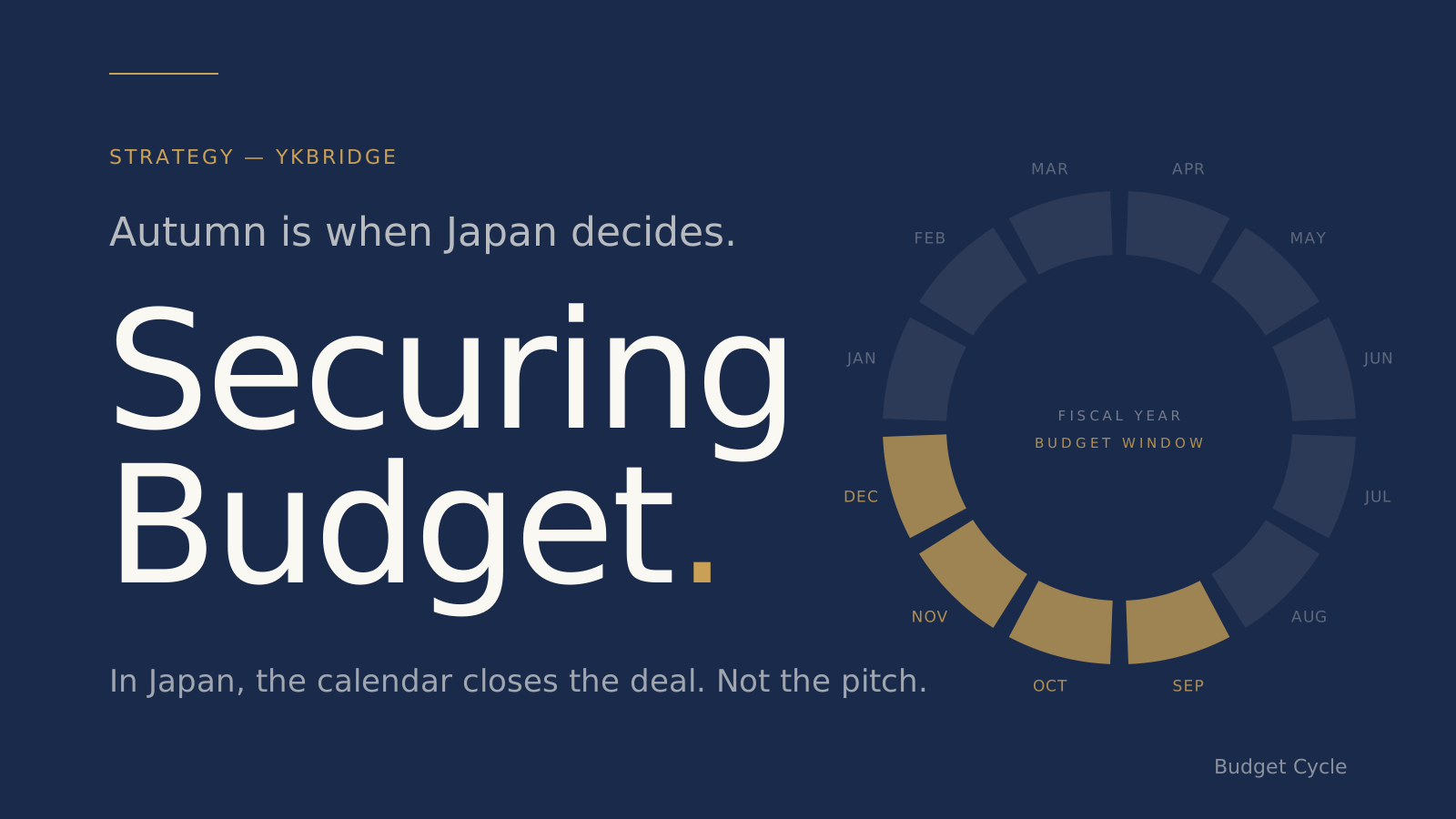
Then revisit the entity question when one of the four triggers fires, and not before. If you are reading this in autumn, the more urgent calendar is the one your customer's budget runs on.
Frequently asked questions
Can a foreign company invoice a Japanese company directly? Yes. Japanese enterprises buy from foreign vendors every day. The work is in the vendor registration, the withholding paperwork and the contract, all of which can be prepared in advance.
Do we have to charge Japanese consumption tax? For digital services sold to a Japanese business, no: the buyer accounts for it under the reverse charge, and your invoice states that. For services performed entirely outside Japan, the sale is outside the scope. For goods, the importer pays at customs. Confirm your case with a Japanese tax adviser.
Will the buyer withhold tax from our invoice? Only if they classify the payment as a royalty, which they may do for software licences. Agree the classification in writing, and file the treaty form before the first payment. US, UK, Dutch and German companies can bring the rate to 0%.
Does setting up a KK speed up sales? Not on its own. A person in Japan, Japanese-language materials and references do. The entity matters for regulated buyers, for employees on your payroll and for inventory.
KK or GK? Either works for a sales subsidiary. KK is more familiar to conservative buyers; GK is cheaper and simpler and is what the largest American technology companies use in Japan.
Can a non-resident be the only director? Yes, since March 2015. Expect the bank account, not the registration, to be the slow step.
When do we need the ¥30 million? Only if someone needs a Business Manager visa to live in Japan and run the company. The capital requirement is immigration law, not company law. Our visa guide covers who it applies to.
This article describes the general shape of the rules as of October 2026 and is not tax or legal advice. Rates, thresholds and treaty terms change; confirm your own situation with a qualified adviser in Japan before you invoice.