Every autumn I have the same conversation with a foreign founder. Their Japanese prospect has been enthusiastic for months. The technical evaluation went well. The champion is real. And then, sometime in November, the tone changes: "We would like to continue the discussion in the new fiscal year."
The founder hears a delay. What actually happened is simpler and more final. The budget for next year was set, and their product was not in it.
The fiscal year starts in April, so the decisions happen in autumn
Most large Japanese companies run their fiscal year from April to March. That single fact drives more of the enterprise sales calendar than any cultural explanation you will read.
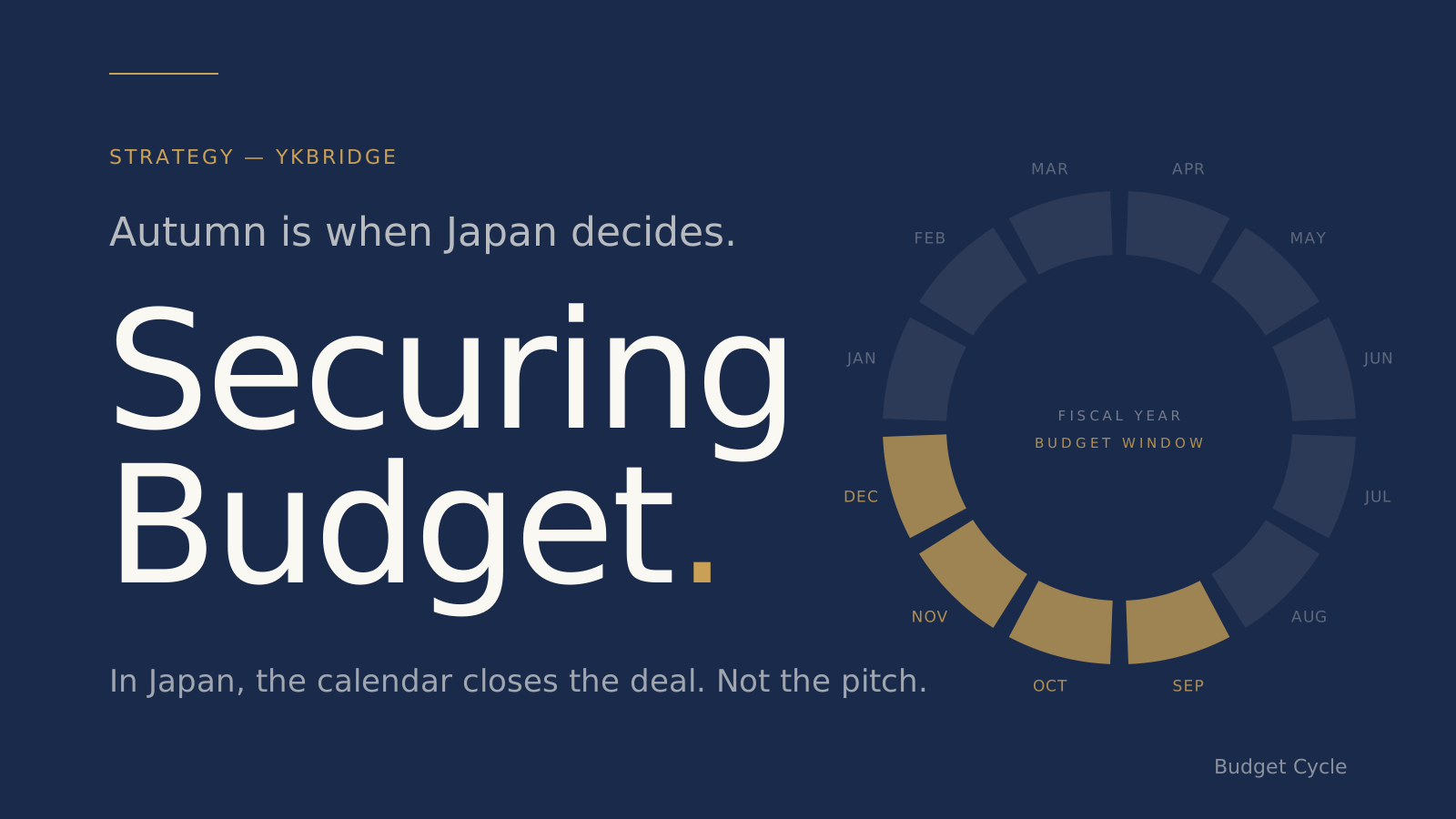
The budget for the year beginning in April is not decided in April. Typically, business units start drafting their requests in September or October. Those drafts are consolidated, challenged and cut through November. By December, and in many companies before the year-end holidays, the numbers are broadly fixed. January to March is for formal board approval and internal announcements, not for adding new items.
So the working window for getting a new vendor into next year's budget is roughly September to early December. If you are reading this in September, you are inside the window. If you are reading this in January, you are looking at April of the following year, and a sales cycle that just grew by twelve months.
This is why so many "12 to 24 month" enterprise deals in Japan are not really long sales cycles. They are ordinary sales cycles that missed one budget window and had to wait for the next.
What "in the budget" actually means
Foreign teams often assume that if the champion has authority and the price is reasonable, the money can be found. In Japan, that is rarely how it works below the executive level.
A department manager can spend against an approved line. He generally cannot create one mid-year. Unbudgeted spend requires a ringi (稟議), an internal approval document that circulates for signatures, and the larger the amount or the less precedented the vendor, the more signatures it collects. A mid-year request for a new foreign vendor with no Japanese entity and no existing relationship is the kind of ringi that gets politely parked.
Being "in the budget" means one of three things, in descending order of strength:
- A named line item. Your product, or a category that clearly maps to it, with an amount attached. This is what you want.
- A reserved allocation. A general budget for "DX initiatives" or "supply chain visibility tools" that your champion intends to spend on you but has not committed to. Better than nothing, and vulnerable to being redirected.
- A verbal intention. "We plan to address this next year." This is not budget. Treat it as a lead, not a forecast.
The difference between the first and the third is usually not how much the customer likes you. It is whether your champion had the material to write the request in the form his finance team expects, at the moment it was due.
The pilot trap, seen from the calendar
In an earlier piece I wrote about why Japanese pilots so often fail to become contracts. The budget calendar is the other half of that story.
Picture a typical sequence. First contact in spring. A pilot agreed in June, funded from the champion's discretionary budget because the amount is small. The pilot runs July to September. Results are good. Everyone is pleased. The team starts drafting a commercial proposal in October.
That timing is already tight. The champion needs to have submitted a budget request for the full deployment while the pilot was still running, ideally with preliminary results in hand. If the proposal only lands in mid-November, it enters a process that is closing, not opening. The most common outcome is a smaller, "phase two" pilot funded from whatever remains, and the real contract slips to the following April.
The fix is not a faster pilot. It is designing the pilot so that its interim results arrive in time for the budget draft, and telling the champion explicitly that this is the goal.
What to do in September and October
If you have live opportunities in Japan right now, these are the actions that move a deal from a verbal intention to a line item.
Ask directly about the budget calendar. "When does your department submit next year's budget request?" is a normal question in Japan and your champion will usually answer it precisely. Then work backwards from that date.
Give your champion a document he can forward. Not your deck. A one- or two-page Japanese-language summary that reads like an internal proposal: the business problem, the expected effect, the cost over three years, the implementation burden on his team, and reference customers. Japanese budget requests are built from documents like this, and if you do not provide one, your champion has to write it himself, which usually means he does not.
Quote in a shape that fits a budget line. Annual amounts in yen, with a clear split between one-time and recurring costs, and a three-year view. Monthly USD pricing that fluctuates with the exchange rate is hard to put in a Japanese budget spreadsheet and easy to cut.
Offer a scoped first year. A phase-one deployment with a fixed amount is far easier to approve than an open-ended enterprise rollout. You can expand in the following cycle once you are an existing vendor, which is a much lighter approval than a new one.
Find out who else needs to say yes. Budget requests above a certain size are reviewed by corporate planning (経営企画) and finance, and sometimes by an IT governance or procurement function. Your champion knows who they are. Ask whether there is anything those reviewers will want to see, and provide it now rather than in December when they ask.
What to do if you have already missed it
If your deal did not make this year's budget, you have two realistic paths.
The first is a small, clearly scoped engagement that fits within the discretionary budget a manager can approve without a ringi. In many companies this is a modest amount, but it keeps you active, produces results that go into next autumn's request, and makes you an existing vendor. Existing vendors get renewed. New vendors get evaluated.
The second is to use the intervening months to widen the account. Meet the corporate planning team, meet a second business unit, meet the person who will actually review the budget request next year. When the window opens again in September, you want to be a known quantity with two sponsors rather than a name on one manager's wish list.
What does not work is waiting. A deal that goes quiet from December to March does not resume in April at the same temperature. Your champion's priorities will have been reset by the new fiscal year, and there is a fair chance he has been rotated to a different role, which is another rhythm of the Japanese corporate calendar that foreign teams rarely plan for.
The calendar is the strategy
Most of the advice on selling in Japan is about people: building trust, reading the room, respecting hierarchy. All of that matters. But a great deal of what looks like relationship difficulty is really calendar difficulty. The customer was not hesitating. The money simply was not there yet, and would not be until April.
Plan your Japan pipeline around the budget year, not around your own quarter. If a prospect is worth pursuing, the question to ask this month is not "can we close by December" but "can we get into next year's budget by December." Those are different questions, and only the second one has a good answer in Japan.