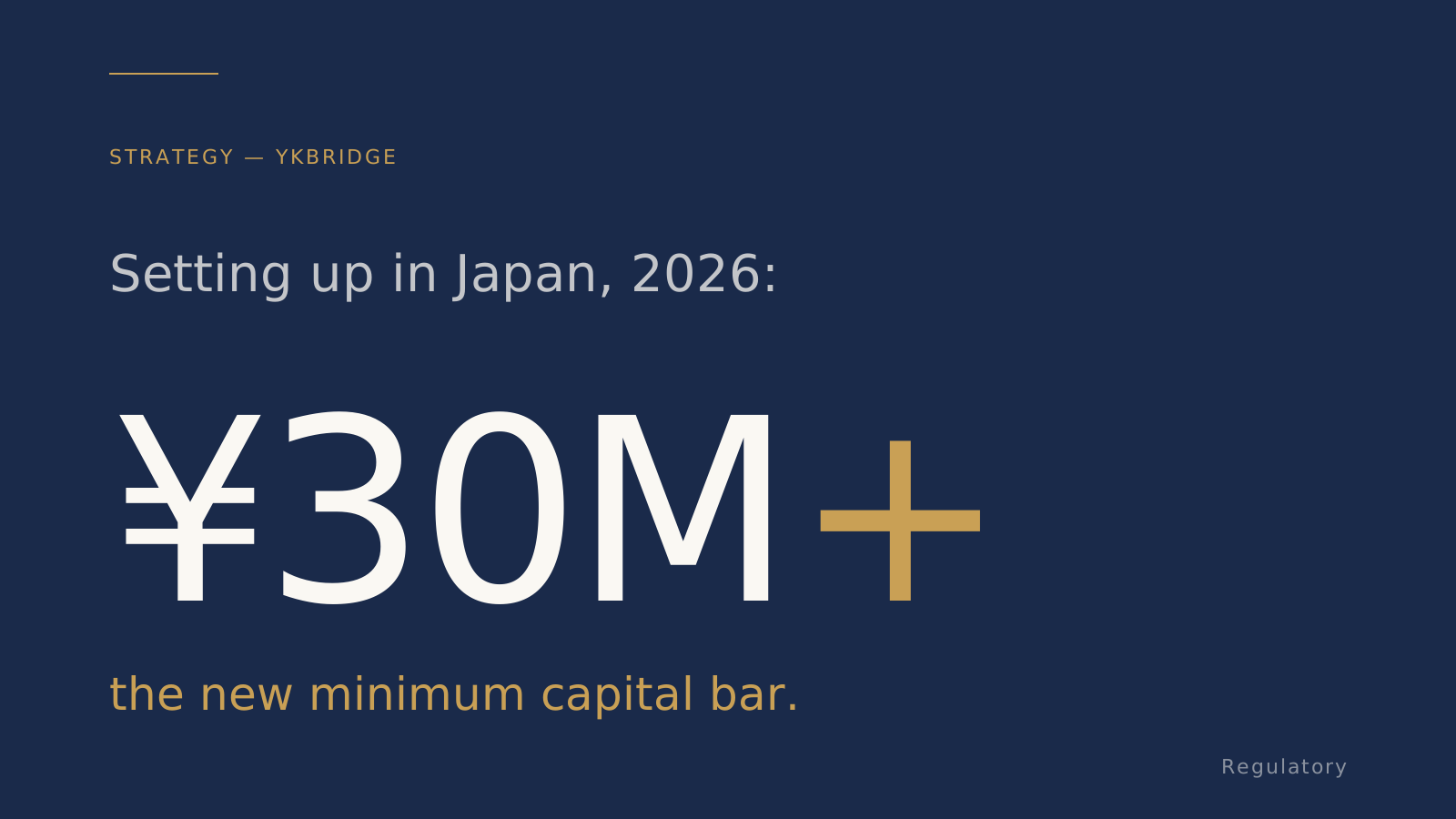
Japan's October 2025 visa reform just raised the capital bar from ¥5 million to ¥30 million — a sixfold increase that rewrites every market-entry budget spreadsheet. If you're planning a Japan launch in 2026, the era of "lean and cheap" testing is over, but the opportunity in the world's fourth-largest economy has never been sharper for well-capitalized startups willing to commit.
The landscape for foreign companies entering Japan has fundamentally shifted. Following the strict regulatory overhaul by the Immigration Services Agency on October 16, 2025, the "fast and cheap" market testing approach is dead. But here's the silver lining: the weak yen gives your foreign-currency budget roughly 30% more purchasing power compared to 2021 levels, and digital-first strategies can dramatically reduce traditional setup costs — if you know where to cut and where to invest.
The new reality: capital requirements that actually matter
The Business Manager Visa reform represents the most dramatic shift in Japan's foreign investment landscape in decades. The minimum capital requirement jumped from ¥5 million to ¥30 million (approximately $200,000 USD), but that's just the headline number. The realistic minimum to operate is closer to ¥35–40 million when you factor in mandatory employee salary costs and the new requirement to employ at least one qualifying full-time Japanese national or permanent resident.
These changes don't apply if you're not planning to reside in Japan yourself — but you'll still need a Japan-resident representative director and a credible operational setup. The Immigration Bureau now requires physical business premises where "business is physically conducted," meaning virtual offices and P.O. boxes are immediate grounds for visa rejection.
For many startups, this capital barrier makes Employer of Record (EOR) solutions increasingly attractive. Starting from roughly $488 per month per employee, EOR can bypass the ¥30 million visa requirement entirely while providing full statutory compliance — perfect for teams of 1–15 employees testing the market.
The hidden multipliers: employment costs that surprise every CEO
Japan's employment cost structure catches every foreign CEO off guard. Statutory employer social insurance and labor insurance contributions add 14–18% on top of gross monthly pay, while semi-annual bonuses of 2–4 months' salary are culturally near-mandatory for retention, even if not legally required.
Here's the real math: a software engineer averaging ¥700,000 per month (≈$4,670 USD) actually costs you ¥815,000 per month (≈$5,440 USD) after employer contributions. Total employment cost follows this formula: (Base Salary × 1.175) + Recruitment Costs + Setup Costs + Annual Admin. Entry-level roles cost a minimum ¥3,500,000–¥4,000,000 annually including all mandatory contributions.
Salary benchmarks break down as follows:
- Clerical roles: ¥200,000–¥300,000/month
- Mid-level professionals: ¥350,000–¥600,000/month
- Engineers/developers: ¥500,000–¥900,000/month
Adding to the complexity, a new Child and Childcare Support Contribution of 0.23% took effect in April 2026 as an additional employer-only levy. Factor in recruitment costs, and your first Japanese hire represents a significant six-figure annual commitment.
Corporate structure: where government fees meet professional reality
Here's where the numbers get interesting. Government incorporation fees remain surprisingly low: a Kabushiki Kaisha (KK) costs approximately ¥182,000–¥222,000 in registration fees, while a Godo Kaisha (GK) runs just ¥62,000–¥102,000. Apple, Amazon, and Google all operate in Japan through GK structures, benefiting from lower setup costs, no board of directors requirement, and flexible profit distribution.
But professional fees add up fast. Judicial scrivener fees range from ¥100,000 to ¥300,000 for setup, while ongoing accounting and bookkeeping runs ¥300,000–¥800,000 per year for a small business. Add Tokyo office space — which varies dramatically from ¥20,000/month for serviced micro-offices to ¥34,000–¥37,000 per tsubo for Grade A space — and your monthly overhead quickly reaches substantial figures.
Traditional Tokyo office leases demand a refundable deposit of 6–12 months' rent, a non-refundable deposit of 1–2 months' rent, plus the agent's commission of 1 month's rent. Most startups opt for serviced offices or coworking spaces in areas like Taito-ku or Shinjuku-ku to avoid these upfront costs.
The tax landscape is also shifting. A new 4% special defense surtax on corporate income tax takes effect in April 2026, raising the already-substantial effective corporate tax rate from 30–35% to even higher levels for most foreign subsidiaries.
What this means for your expansion plans
The math is clear: establishing and maintaining a Japanese subsidiary costs $30,000 to $50,000 upfront and $5,000 to $10,000 per month in ongoing overhead. For small teams, EOR solutions at $300–$600 per employee per month often make more financial sense than full incorporation.
Your entry strategy should match your commitment level. Use EOR for market testing with 1–5 employees. Choose a GK structure for lean operations when you're ready to commit but want to minimize bureaucracy. Opt for a KK when you need maximum credibility for partnerships, enterprise sales, or eventual capital raising in Japan.
Banking remains a critical early hurdle: once rejected by a bank, reapplying to the same institution is generally impossible. Careful preparation before your initial application is essential — this isn't a process you can afford to rush or retry.
The era of "lean and cheap" Japan market entry may be over, but for well-capitalized startups, the barriers have simply shifted from regulatory complexity to capital commitment. With the weak yen providing significant purchasing power advantages and proven low-cost entry vehicles like EOR solutions, Japan remains one of the world's most attractive expansion markets — you just need to budget accordingly from day one.